

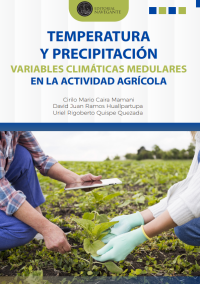
Temperature and precipitation: Core climatic variables in agricultural activity
Keywords:
precipitation, temperature, climate, agricultural activitySynopsis
In this century the effects of climate change have intensified in various parts of the world. The cause of this fact is primarily due to global warming, which consists of the rise in the average temperature of the earth.
This has caused significant changes in the elements of the climate: the atmospheric temperature increases each period; Precipitation in general becomes irregular; since in some areas there is a decrease, while in others there has been an increase; changes in the frequency and speed of winds and, finally, the considerable increase in solar radiation. Each of these variations causes a multiplicity of immediate effects at the meteorological level that, in turn, have repercussions at the ecological, biological, economic, social and even political level.
In the present study, the interest focuses on the effects that climate change produces on an economic and technical activity such as agriculture. Agriculture is one of the activities most affected by climate change, since it has a direct relationship with certain elements of the climate, such as temperature and precipitation; Since, for the cultivation of food, whether it is produced on a large scale or if, on the contrary, it is only developed for self-consumption or family consumption, it is necessary that there be regularities in temperature and precipitation.
In the case of the Andes of South America, these consequences are more noticeable, since the mountains are more sensitive to climate change, a product of their latitude and proximity to the middle troposphere. In this sense, global warming has begun to produce an increase in temperature in these areas, there has also been a melting of glaciers and a decrease in precipitation, factors that directly harm the agricultural activity carried out in those areas. places.
Therefore, it is vitally important to know the impact and relationship that certain meteorological variables, as a result of climate change, are affecting agriculture, with the aim of adopting measures that allow counteracting the effects of those changes, as well as generating policies and guidelines for the farmers that allows them to adapt their practice to benefit their production and sustenance.
Downloads
Download data is not yet available.
Downloads
Published
April 20, 2024
Copyright (c) 2024 Submission Editorial Navegante
License

This work is licensed under a Creative Commons Attribution-NonCommercial-NoDerivatives 4.0 International License.


 contacto@editorialnavegante.com
