

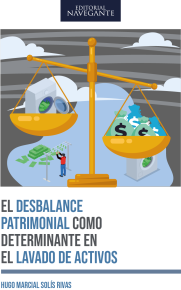
Asset imbalance as a determinant in money laundering
Keywords:
unbalance, patrimonial, laundering, moneySynopsis
The objective of this book is to establish and describe the relationship between the wealth imbalance and money laundering, as well as to determine if the judicial accounting expert opinion is a reliable tool to identify if there is a case of money laundering; This study is presented as a response to the growing ignorance of the civilian population about their tax duties and the growth of the crime of money laundering worldwide and its effects on Peruvian communities that have a low police presence, in order to create awareness among taxpayers about the importance of educating themselves on tax issues, financial management and promoting the formalization of businesses to establish a more stable and secure economy for all taxpayers.
In the first chapter, the concept of equity imbalance is defined and its relationship with the unjustified increase in equity is established from the equity, tax and presumed net income approaches; Next, the cases of autonomous patrimonies that are contemplated in the Peruvian legislation and their incidence in the tributary obligations are presented; and then, the importance of Income Tax and the obligations it entails according to the principles outlined above were addressed. Likewise, this chapter establishes the common principles between the approaches presented and the contradictions that these legal figures present within Peruvian legislation.
The second chapter deals with the characteristics and differences between the control and the expert evaluation of the patrimonial imbalance as legal procedures that are used in cases of patrimonial imbalance and presumption of unjustified patrimonial growth; To this end, this chapter establishes the way in which tax obligations are determined and the burden of proof that some tests have in the event of an investigation of a tax debtor; In addition, the International Accounting Standards and the International Financial Information Standards are presented as a normative reference and the instrument of the Patrimonial Declaration as the basis of all tax investigation. Based on the aforementioned, this chapter allows readers to understand the differences between the different evaluation procedures related to tax debts, their use cases, techniques and legal processes with the aim that debtors are able to understand their legal situation in case of being investigated.
In the following chapter, it introduces the crime of money laundering and its incidence and impact worldwide, for which the definition of this type of crime, its main characteristics and the communities and sectors it affects are addressed; In turn, the phases that money laundering includes and the main mechanisms used in each phase are presented; then, the techniques of professionalization of money laundering that emerged in correspondence with the growth of this crime worldwide are shown; Finally, some types of money laundering are defined according to different criteria that allow determining degrees of criminality in the case of money laundering. This third chapter urges readers to promote the formalization of businesses and avoid involvement with criminal networks whose enrichment does not have positive effects on the community.
Finally, in the fourth chapter, a case study is carried out regarding the patrimonial imbalance present in the grocery trade sector in the town of Aucayacu during the period from 2012 to 2017; This study is presented as an approach to the perception that the communities involved in circumstances of presumption of money laundering have regarding the suspicions that their businesses generate and the validity of the techniques used for the investigation of tax crimes. Throughout this chapter, the concepts mentioned in the previous chapters are used to establish the hypotheses, variables and research techniques; Likewise, the results are presented and interpreted according to the principles outlined above and according to the opinion of the population involved.
In this way, this book instructs and exhorts readers to remain in the formality and comply with their fiscal obligations to reduce the growth of crime, violence, corruption and the inequitable distribution of wealth at the national and global levels.
Cite (APA)
Solís, H. (2023). El desbalance patrimonial como determinante en el lavado de activos. Editorial Navegante. https://submission.editorialnavegante.com/index.php/SEN/catalog/book/163
Downloads
Download data is not yet available.
Downloads
Published
May 22, 2023
Categories
Copyright (c) 2023 Submission Editorial Navegante
License

This work is licensed under a Creative Commons Attribution-NonCommercial-NoDerivatives 4.0 International License.


 contacto@editorialnavegante.com