

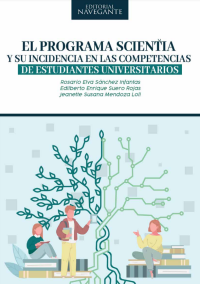
The Scientia program and its influence on the skills of university students
Keywords:
scientia program, incidence, skills, University studentsSynopsis
Currently in the world, the true exercise of sovereignty and freedom lies in knowledge, research is required to reduce the limits of ignorance and increase the ability to solve problems. With this, a better quality of life can be achieved in a country that has highly trained human resources in centers capable of generating knowledge and training imaginative professionals who can create and innovate.
To this, research promotes critical thinking, creativity and it is through it that the learning process is strengthened and confronts memorization, which has long contributed to the formation of passive professionals, little interested in innovation. , and with little curiosity or interest. On this, the investigation is transcendental in higher education, since it is not feasible to achieve high-level graduates if it is not investigated.
Likewise, within the field of research there is a type called applied research, which is a tool that, for many years, has served humanity, whose objective is, in the scientific field, to seek to convert pure knowledge into practical knowledge. and useful to society. Through this methodology, new proven knowledge can be created in all areas of thought. Thus, applied research falls into the category of research according to the object of study, where it shares with analytical, basic and field research.
On the other hand, society tends more and more to be based on knowledge, therefore, higher education and research are essential for the cultural, socioeconomic and ecologically sustainable development of individuals, nations and communities. However, higher education itself is transformed and renewed, so that today's society can extend solely economic considerations and assume more established dimensions of spirituality and morality. The comprehensive training of professionals and intellectuals requires a continuous and in-depth analysis of educational standards (approaches, technologies, those involved, and applications in the training processes).
On the other hand, there is a global educational trend in the formation of competencies, a term with many meanings and explained from several different approaches, which have as a common point to be considered as an integral and varied group of personal characteristics, integrated by knowledge, understanding , attitudes and skills that give them skills to respond to explicit and implicit demands in a specific field or area. Similarly, the different approaches to competencies agree that they have cognitive, procedural, and attitudinal-evaluative components.
In this sense, the proposal proposed here implies the analysis and evaluation of the socio-formative approach, which conceptualizes competencies as an integral and complex category that enlists its holder to face contemporary professional problems, immersed in change, the complexity and uncertainty. From this point, a proposal was developed, the Scientĭa Program, aimed at developing research, contextual and comprehensive skills, while contributing to the comprehensive development of students. In addition, in this proposal some applications of various approaches to psychology were also incorporated: the behavioral approach, positive psychology, the cognitive approach and the humanistic approach.
Cite (APA)
Sánchez, R., Suero, E., & Mendoza, J. (2023). El programa Scientia y su influencia en las competencias de estudiantes universitarios. Editorial Navegante. https://submission.editorialnavegante.com/index.php/SEN/catalog/book/168
Downloads
Download data is not yet available.
Downloads
Published
January 20, 2023
Copyright (c) 2023 Submission Editorial Navegante
License

This work is licensed under a Creative Commons Attribution-NonCommercial-NoDerivatives 4.0 International License.


 contacto@editorialnavegante.com
