

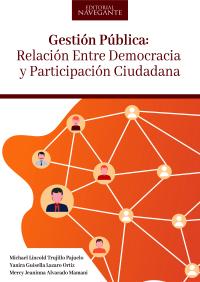
Public management: Relationship between democracy and citizen participation
Keywords:
Public Management, democracy, citizen participationSynopsis
In a democratic government system based on the principle of morality and political equality of the citizen, as Calvet (2018) points out, it is essential to have citizen participation, not only in electoral activities but also in learning about the state and the problems that it happens in society. Kolesnik et al. (2020) highlight the importance of citizen participation in solving local problems related, for example, to health care, the state of the environment, education, political and economic problems, among others.
On the other hand, Shack and Arbulú (2021) argue that citizens are currently more active in political and economic affairs in Peru; however, there is discontent regarding the form of public decisions. This is due to the fact that the population is not informed of the existing mechanisms (referendum, legislative initiative, accountability, among others) and their application, as well as the ignorance of their rights as established in the Constitution.
Due to what the authors mentioned, it is urgent that citizens have knowledge about what citizen participation implies to avoid discomfort and disagreement with local and regional management. The people are not only there to elect a representative, but also to participate in matters related to the development and well-being of the country. The 1993 Constitution highlights the participation of citizens and native peoples in matters involving their well-being and the growth of the country.
In this sense, the first chapter deals with the general notions that citizen participation implies, either as a political right, and about how public institutions are strengthened through the development of mechanisms of self-sufficiency and transparency.
The second chapter delves into what the term democracy implies and its principles established in the sessions of the General Assembly of the United Nations, as well as the development of the classification of democracy: indirect or representative, semi-direct or participatory and, for Lastly, direct democracy.
The third chapter focuses on citizen participation in Peru, where the duties and rights of all Peruvian citizens are identified in terms of the application of various mechanisms that citizen participation entails. A brief diagnosis is also developed in relation to the attitude towards the problems of Peruvian society and the benefits of participatory democracy in the country.
Finally, the fourth and fifth chapters detail the analysis of citizen participation and democracy within the public management of the Municipality of Los Olivos during the 2016 period and the final reflections on the need for citizen participation in the public decisions of Peru, respectively.
Cite (APA)
Trujillo, M., Lázaro, Y., & Alvarado, M. (2022). Gestión pública: Relación entre democracia y participación ciudadana. Editorial Navegante. https://submission.editorialnavegante.com/index.php/SEN/catalog/book/169
Downloads
Download data is not yet available.
Downloads
Published
December 30, 2022
Copyright (c) 2023 Submission Editorial Navegante
License

This work is licensed under a Creative Commons Attribution-NonCommercial-NoDerivatives 4.0 International License.


 contacto@editorialnavegante.com