

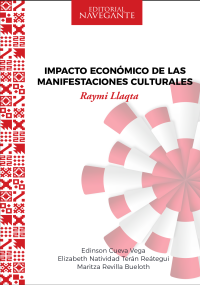
ECONOMIC IMPACT OF CULTURAL MANIFESTATIONS: Raymi Llaqta
Keywords:
economic impact, Raymi Llaqta, cultural manifestations, cultureSynopsis
The present investigation focuses on the Raymi Llaqta Festival that is celebrated in the city of Chachapoyas, capital of Amazonas. This celebration is one of the most important in the Amazon region, taking place on the first Saturday of June. In a single day there is a huge parade where numerous communities parade exposing their customs and traditions, typical dishes, clothing, music, etc. This event attracts several tourists, both national and foreign, who are amazed and amazed at its enormous color and spectacularity.
This event shows the direct and inseparable relationship between economy and culture. For example, the publishing sector needs inputs to be able to put books on the market, a company needs to know its cultural environment to know the tastes and consumption of its customers and launch a new product, among many other cases.
This is due to the appearance of cultural industries, which produce cultural elements on a large scale to obtain a profit by locating creativity in an industrial gear of production whose final product acquires a use value and an exchange value, although in the case As regards cultural assets, these are difficult to assess for the following reasons: being unique, non-reproducible assets, being public assets, and being assets of merit. Everything we have mentioned up to this point refers to cultural capital, a set of symbols, images, narratives, ideas, values and attitudes whose cultural manifestations can be films, works of art, etc., which are culturally produced, exchanged and consumed. by a certain society and that influence economic development in the short and long term.
One of these assets is cultural heritage, a cultural asset recognized as a sign of collective identity by the members of a society and that can become a focus of tourist attraction that generates economic and social assets for society and the country. In the same way, you can appreciate other manifestations that can be used by the private and public sector for their insertion into the cultural capital such as dances, music, meals, parties, etc.
For this reason we chose to study the Raymi Llaqta Festival, analyzing its socioeconomic impact and seeing its tourist potential to insert it into the cultural capital. A descriptive and explanatory investigation was carried out in the present manuscript, where the variables were not manipulated, taking as the main population the tourist lodging, food and travel agency servers using interviews and surveys.
The results showed that the event does not have its own budget, being the municipality of Chachapoyas who assumes the expenses by including it in its tourist week and many of the tourists are not attracted by the event but are in transit to the Kuelap Fortress; which causes the tourist service providers to advise that the Raymi Llaqta be an exclusive event and be disseminated nationally and internationally. In addition, it is also recommended that there be an organization that includes all the actors of the population to promote this festivity, as well as support from the private sector and the media.
Cite (APA)
Cueva, E., Terán, E., & Revilla, M. (2023). Impacto económico de las manifestaciones culturales: Raymi Llaqta. Editorial Navegante. https://submission.editorialnavegante.com/index.php/SEN/catalog/book/176
Downloads
Download data is not yet available.
Downloads
Published
September 28, 2023
Copyright (c) 2023 Submission Editorial Navegante
License

This work is licensed under a Creative Commons Attribution-NonCommercial-NoDerivatives 4.0 International License.


 contacto@editorialnavegante.com
