

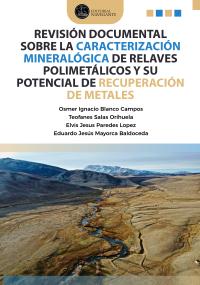
Documentary review on the mineralogical characterization of polymetallic tailings and their potential for metal recovery
Keywords:
mineralogical characterization, polymetallic tailingsSynopsis
In Peru, tailings reuse has ceased to be a pipe dream of mining engineering and has become the epicenter of a necessary, albeit belated, metallurgical metamorphosis. Historically, the country has managed its mining waste with a logic of confinement and neglect, accumulating thousands of deposits that, until recently, were considered merely environmental liabilities with high geotechnical and chemical risks. However, contemporary research, driven by the scarcity of new deposits and the demand for critical metals, is redefining these deposits as "secondary deposits" that are being revitalized by integrating the circular economy as a strategic axis. This supports the current mining sector's approach, which seeks to break the linear cycle of active remediation by processing tailings and neutralizing their polluting potential, transforming a legacy of degradation into an engine of economic and environmental revitalization.
However, despite this optimism, the future of mining faces a critical crossroads that demands rigorous honesty in declaring that the viability of tailings reprocessing depends not only on precision metallurgy, but also on a paradigm shift in governance and social license. Simply presenting the circular economy as the sole philosophy of sustainability is insufficient. The research presented here proposes that tailings treatment should be the operational standard of modern mining, where success is not measured by the tonnage extracted, but rather by the capacity to generate natural capital. Only through a critical analysis of the failures of the previous model and the implementation of real-time monitoring systems can Peruvian mining ensure that the utilization of its liabilities is, in fact, the first step towards an industry that restores the territory's systemic balance.
Downloads
Download data is not yet available.
Downloads
Published
April 8, 2026
Categories
Copyright (c) 2026 Submission Editorial Navegante
License

This work is licensed under a Creative Commons Attribution-NonCommercial-NoDerivatives 4.0 International License.


 contacto@editorialnavegante.com