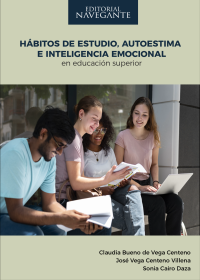
Study Habits, Self-Esteem, and Emotional Intelligence in Higher Education
Keywords:
Study habits, self-esteem study, emotional intelligenceSynopsis
In the evolution and development of the human being, knowledge is very important from the beginning, because this component influences its progress. New technology, new technological resources, new computer tools, clothing innovation, etc., is the result of knowledge. Starting from this, it is necessary to mention that to acquire this knowledge, learning is used. It is inferred, meanwhile, that learning plays an indispensable role. Learning is seen as a fundamental process in which the human being develops his abilities, skills and competencies to acquire new knowledge. In this process the person makes use of cognitive mechanisms, these will allow him to reflect, understand and analyze information and then transform it into knowledge. Therefore, learning, as a basis of knowledge, is to "incorporate information", this conception lies in behaviorist pedagogy, where acquiring knowledge occurs through reinforcing agents. (Roman et al., 2021).
When we talk about knowledge, in general, we relate it to the scientific and technological innovations of what we obtain and that are the cause of what was previously mentioned, of the knowledge acquired through learning. Meanwhile, it is in the universities, where the training of scientists, researchers and specialists from different areas or professional schools usually comes from, who build a better future for society, causing and strengthening the well-being of the environment for themselves and for others. (Soto and Torres, 2016).
There are many disciplines interested in addressing the learning model, this process where the individual is able to develop their abilities in order to optimize the acquisition of new knowledge, concerns a large number of participatory agents, whether: the teacher, the students, the family, the social environment, the media, etc. In this sense, the teacher, who actively participates in this process, must take into account the appropriate methodology and related to their students to achieve effective results. Therefore, this approach goes hand in hand with strategies, techniques or tools that help deepen student performance. Ávila and Cortés (2017) mention that for the competitive development of university students it is necessary to promote critical judgments, which lead to reflection, recreation and reinforcement of learning, at the same time, making students responsible and aware. both of their personal growth and with the outside.
Many times, it can be very complicated for students of a higher educational level to adapt to this new stage of training, since the sequence of new experiences is decisive in academic performance. A student who is starting his professional training is looking forward to meeting new challenges and challenges that are put in front of him; however, there are emotional, cognitive and behavioral conditions that can hinder the completion of these purposes, such as: study habits, self-esteem, emotional intelligence. Habits such as repetitive behaviors that are part of the quality and lifestyle; self-esteem as a decisive factor for the recognition of the physical, psychological or mental state of a person and emotional intelligence as an influential mental capacity in decision-making. In this case, the student must be aware of the good management of their attitudes and skills, have the initiative to grow personally and expand their vision of knowledge in order to commit to creating new changes that society deserves and reflect on the new responsibilities that are assigned to it.
Cite (APA)
Bueno, C., Vega, J., & Cairo, S. (2023). Hábitos de estudio, autoestima e inteligencia emocional en educación superior. Editorial Navegante. https://submission.editorialnavegante.com/index.php/SEN/catalog/book/46
Downloads
Download data is not yet available.
Downloads
Published
October 13, 2023
Categories
Copyright (c) 2023 Submission Editorial Navegante
License

This work is licensed under a Creative Commons Attribution-NonCommercial-NoDerivatives 3.0 Unported License.


 contacto@editorialnavegante.com