

The millennials and their relationship with information and communication technologies in the framework of the democratic exercise
Keywords:
ICT, millennial, representative democracy, neoliberalismSynopsis
Today's society, a globalized one, is characterized, mainly, by the use of information and communication technologies (ICT), as well as by the rapid diffusion and large amount of available data; In this regard, Silva (2017) indicates that the people who have the greatest capacity to access and manage the abundant information available are those who hold power, a situation that, for example, in modern society (product of the Industrial Revolution) was completely different: power is mediated according to the means of production.
Globalization at the social level is part of the introduction of a neoliberal and capitalist socioeconomic model, as Grajales and Osorno (2019) affirm, this phenomenon is multidimensional, because it produced a set of structural changes in society, oriented, in mostly, to the guidelines of the exposed models. Likewise, the impact of this model affects all areas of human activities (primarily cultural, social and economic). On the other hand, it is also added that the introduction of technology in this model of society reinforces its impact on human life and that, vice versa, globalization strengthens the use of the former: thus, a feedback relationship is established between both. components.
It should be noted that not all the effects of globalization are positive; In the academic literature, a large number of studies are noted in which it is stated that, after its introduction, the social and economic gaps between human beings have increased substantially (Bourguignon, 2017; Grajales and Osorno, 2019), therefore that, in recent decades, there have been a series of protests of various magnitudes that demand changes to their governments, especially, in the taking of actions against the effects of globalization. On the other hand, in the case of Latin America, the nature of representative democracy has been discussed, especially in those cases in which elected representatives commit crimes of corruption, embezzle budgets or impose economic reforms that affect the most vulnerable sectors. of the society.
It follows, therefore, that when comparing today's society with that of 25 or 50 years ago, there are abysmal differences in the means of communication, lifestyles and ideologies of people. These phenomena have been identified in research in the field of Social Sciences: the interaction of new actors has been discovered, who demand changes in society in the socioeconomic, political, cultural, environmental fields, among others (Solórzano, 2019).
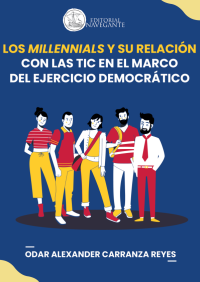
In this regard, these new actors are assigned to a specific generation; in the literature, the coexistence of three generations is highlighted today: Baby Boomers, X, Millennials (or Y) and Centennials. In general, according to the diversity of definition proposals, each of these are distinguished by presenting a different conception of the world, being born in close dates, sharing historical events, among other factors (Díaz-Sarmiento et al., 2017).
Exposing these scopes, throughout this book, the theoretical basis of each of the concepts mentioned is developed: a) globalization and its impact on society, b) ICT, its characteristics and use in current generations and c) democracy and the problems that exist around its nature (representative or direct). Likewise, an investigation is presented, whose objective was to determine the degree of impact of the use of ICT in the demonstrations and protests carried out by the millennial generation, in different countries of the world (Chile, Ecuador, Bolivia, Mexico, Hong-Kong, France , Spain, United Kingdom, USA, Tunisia, Libya, Egypt), with special attention, in Peru, during the period 2011-2019.
Cite (APA)
Carranza, O. (2022). Los millennials y su relación con las tecnologías de la información y comunicaciones en el marco del ejercicio democrático. Editorial Navegante. https://submission.editorialnavegante.com/index.php/SEN/catalog/book/65
Downloads
Download data is not yet available.
Downloads
Published
November 7, 2022
Copyright (c) 2022 Submission Editorial Navegante
License

This work is licensed under a Creative Commons Attribution-NonCommercial-NoDerivatives 4.0 International License.


 contacto@editorialnavegante.com