

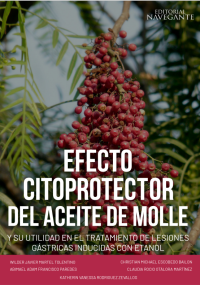
Cytoprotective Effect of Molle Oil (Schinus molle) on Gastric Lesions Induced with Ethanol in Rats
Keywords:
cytoprotective effect, molle oil, gastric lesions, ethanol, ratsSynopsis
Currently, gastric conditions occur due to various factors that are usually very common in a country like Peru, so most citizens resort to alternative treatments such as herbal medicine because it is usually a low-cost and easily obtained treatment. . However, it has been confirmed that there are few experimental works that analyze and demonstrate the effectiveness that phytotherapeutic treatments can have on gastric conditions and if the effects that occur can be compared with the effects produced by conventional treatments. Because Peru is recognized as one of the countries with a diversity of flora and fauna, it has been established that plants can be used as a medicinal treatment; such is the case of the arboreal species Schinus molle L., which is a tree native to Peru that has a maximum growth of 20 meters in height and a thick, woody and tortuous trunk with frequent cortical excrescences. Likewise, it is a highly branched tree whose foliage frequently reaches a diameter that exceeds its height and tends to have an intense aroma and a bitter and slightly spicy taste at the level of the pharynx. The leaves are abundant, compound, coriaceous, imparipinnate and with a long petiole, allowing it an elegant and very showy foliage; its flowers are present in clusters and are small and whitish in color, but when they bear fruit and mature they have a very attractive pinkish color that gives showy green panicles. (Pozzo-Balbi, Nobile, Scapini & Cini, 1978).
On the other hand, gastric disorders are diseases of the digestive system that have been diagnosed as a clinical-social problem that generate economic repercussions at a regional and global level since, in recent years, their incidence and morbidity have increased in the wide distribution. geographic. Likewise, gastric lesions such as peptic ulcer and gastritis are diseases that acutely or chronically inflame the gastric mucosa and are usually produced by endogenous and exogenous factors, causing dyspeptic symptoms (pain, burning, pressure, etc.) that require a histological confirmation and endoscopic observation.
In this way, studies have determined that the leaves and fruits (berries) of Schinus molle L. contain essential oil (EO) and that this oil is usually used in the treatment of gastritis, gastropathies, peptic ulcer disease and other gastric injuries as they have components that help counteract these conditions. Therefore, this research work seeks to know and analyze the cytoprotective effects of molle essential oil (Shinus molle L.) in gastric injuries.
Cite (APA)
Martel, W., Escobedo, C., Otálora, C., Francisco, A., & Rodríguez, K. (2022). Técnicas innovadoras en el manejo conductual infantil para la atención odontopediátrica. Editorial Navegante. https://submission.editorialnavegante.com/index.php/SEN/catalog/book/20
Downloads
Download data is not yet available.
Downloads
Published
October 14, 2022
Copyright (c) 2022 Submission Editorial Navegante
License

This work is licensed under a Creative Commons Attribution-NonCommercial-NoDerivatives 4.0 International License.


 contacto@editorialnavegante.com