

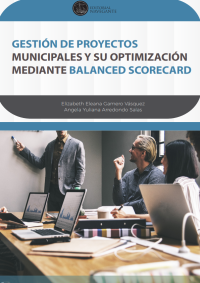
The management of municipal projects and their optimization through the balanced scorecard model
Keywords:
Public management, project management, Balanced Scorecard ModelSynopsis
The management developed by the authorities of a nation aims to maintain the organization and functionality of a given activity. This management entails a certain amount of operations that must be adapted to the principles and norms of such a nation and, in addition, can be distributed among the regional, municipal or local governments of the country. In this sense, municipal management integrates the efforts that are made within a country.
Management, within an organizational group, is understood as the proper execution of activities that allow the fulfillment of beneficial goals for all members of an organization (Armijos et al., 2019). Therefore, municipal management is that set of activities that seek the collective benefit of an entire locality.
Given this, the National Institute of Statistics and Informatics [INEI] (2020) indicates that the "provincial and district municipalities are the government bodies that promote local development" (p. 21), therefore, the senior officials of these municipalities promote what is called municipal management.
This management is supported by planning tools or models that allow the effective fulfillment of all municipal objectives. Paoletta (2016) argues that the prosperity of municipal or local government efforts is associated with the development and implementation of public policies. From this, it is clear that importance must be attached to the choice of strategic measures that promote the efficiency and quality of the services or benefits of an entire locality.
For example, investing in public infrastructure is one of the causes of economic growth and raising the quality of life in the citizens of a country (Instituto Peruano de Economía, 2021), therefore, management in this must be the better.
One of the efforts that development seeks is project management. This management, known as project administration or management, is conceived as a discipline that guides the operations required to undertake, regulate and complete a project, thereby understanding that the objectives of such a project must be met (Siles & Mondelo , 2018). Therefore, implementing project management in municipalities may be feasible to ensure local growth.
On the other hand, the Balanced Scorecard (BSC) Model - also called Balanced Scorecard - is a management instrument that proposes the use of strategies, which cooperate with the achievement of the objectives and the strategy of an organization. In addition, this model allows the interrelation between the organizational strategy and the different levels of a company (Bolaños et al., 2020).
For all the above, it is conducive to have a general overview of project management and the BSC model in order to improve the performance of operations carried out within the management of organizations such as municipalities. The improvement of this management contributes not only to the development of a locality, but of an entire country; that is what Peru currently requires to face the various adversities that occur in any geographical area of the nation.
Downloads
Download data is not yet available.
Downloads
Published
March 18, 2024
Copyright (c) 2024 Submission Editorial Navegante
License

This work is licensed under a Creative Commons Attribution-NonCommercial-NoDerivatives 4.0 International License.


 contacto@editorialnavegante.com